
How to Clean Sterling Silver Jewelry: Step-by-Step Guide
Table of Contents
- What Causes Sterling Silver to Tarnish
- Supplies You'll Need to Clean Sterling Silver Jewelry
- How to Remove Tarnish from Sterling Silver
- Can You Use Dish Soap to Clean Sterling Silver
- Clean Sterling Silver with Baking Soda: Best Practices
- How to Clean Sterling Silver with Gemstones and Delicate Settings
- Polishing and Restoring Shine to Your Sterling Silver
- Long-Term Care and Tarnish Prevention
- Frequently Asked Questions
Last Updated: October 13, 2026
What Causes Sterling Silver to Tarnish
Sterling silver tarnishes when it reacts with sulfur compounds in the air, on your skin, or in your environment, creating a dark surface layer.
Humidity, salt air, chemicals, perfume, lotion, and sweat accelerate tarnishing. Wearing your silver regularly slows it, since friction keeps the surface clean.
At Silver Mexican Treasures, we craft handmade sterling silver pieces to last for years, but tarnish still appears, especially in humid storage or with infrequent wear.

Supplies You'll Need to Clean Sterling Silver Jewelry
You likely have most of these items at home already.
Core supplies for gentle cleaning:
- Mild dish soap (unscented, without degreasers)
- Warm water in a shallow bowl
- Soft microfiber cloth or lint-free cotton cloth
For tarnish removal:
- Baking soda
- White vinegar
- Aluminum foil
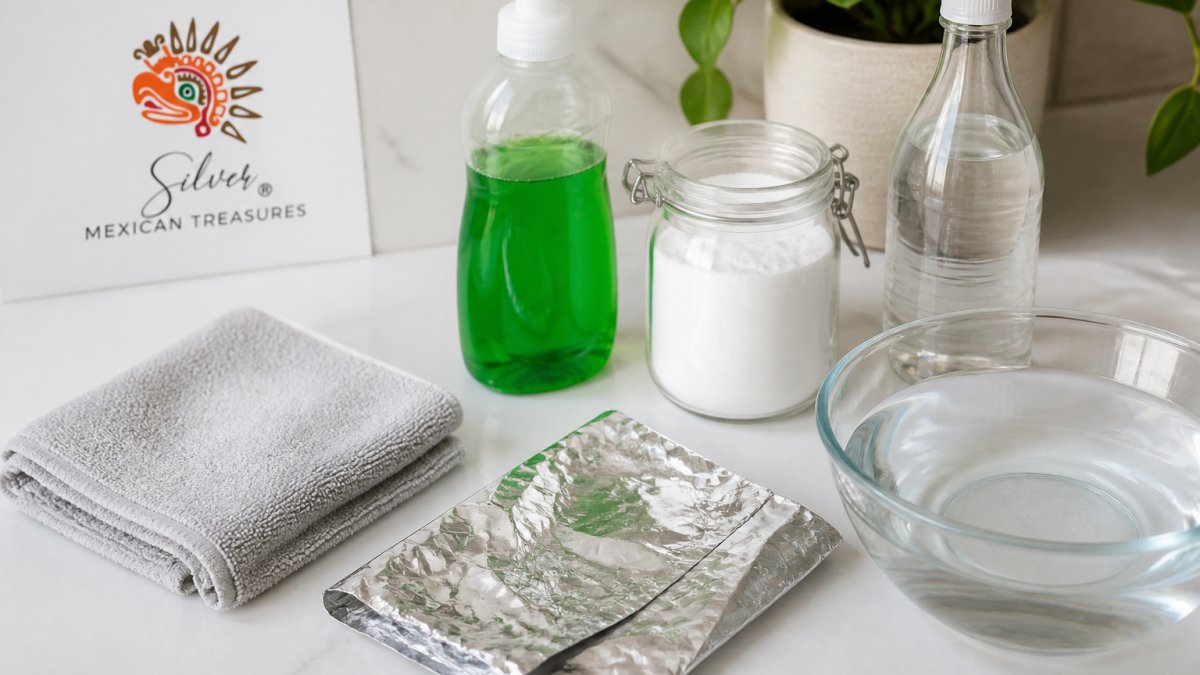
Skip harsh abrasives like steel wool or scouring pads, they scratch silver. Avoid commercial silver dips unless you're experienced, as they can damage certain finishes. A soft cloth is non-negotiable: microfiber grabs tarnish without scratching.
How to Remove Tarnish from Sterling Silver
Removing tarnish depends on buildup and materials: light tarnish needs mild soap and water, while stubborn tarnish requires stronger methods.
Method 1: Mild Dish Soap and Warm Water
This is the safest method for all sterling silver jewelry, especially pieces with gemstones or delicate settings.

Steps:
- Fill a shallow bowl with warm (not hot) water
- Add a few drops of mild dish soap
- Soak your jewelry for 5-10 minutes
- Gently rub the surface with a soft cloth
- Use a soft toothbrush with circular motions for intricate areas
- Rinse under cool running water
- Dry immediately with a clean microfiber cloth
This removes light tarnish and everyday grime, is gentle enough for frequent use, and won't harm gemstones or delicate metalwork.
Method 2: Baking Soda Paste
Baking soda is mildly abrasive and works well for moderate tarnish. It's safe for most sterling silver but should be avoided on pieces with soft gemstones like pearls or opals.
Steps:
- Mix baking soda with a small amount of water to form a thick paste
- Apply the paste directly to tarnished areas
- Rub gently in circular motions with a soft cloth
- Let the paste sit for 5-10 minutes on heavy tarnish
- Rinse thoroughly under cool water
- Dry immediately with a clean cloth
Aim for the consistency of toothpaste. It works faster than soap and water on visible tarnish, but avoid it on antique pieces with patina you want to preserve.
Method 3: Aluminum Foil and Baking Soda
This method uses a chemical reaction to remove tarnish. It works exceptionally well for heavy buildup but requires care with delicate pieces.
Steps:
- Line a shallow bowl with aluminum foil, shiny side up
- Add warm water and a tablespoon of baking soda
- Place your silver jewelry on the foil (it should touch the foil)
- Let it sit for 5-15 minutes depending on tarnish severity
- Remove and rinse thoroughly under cool water
- Dry immediately with a clean cloth
- Repeat if needed for stubborn tarnish
The foil transfers tarnish from your silver to itself, you'll see it darken as it works. It's powerful and fast, but avoid it on jewelry with soft gemstones or delicate settings soaking might damage.
Can You Use Dish Soap to Clean Sterling Silver
Yes, mild dish soap is one of the gentlest and most effective methods for regular sterling silver maintenance.

Choose an unscented, gentle dish soap without degreasers or harsh chemicals, and avoid antibacterial soaps, the goal is to lift dirt and oils, not strip the metal.
Dish soap works best for light tarnish and everyday cleaning; for heavy buildup, use baking soda or the foil method.
Clean Sterling Silver with Baking Soda: Best Practices
Baking soda removes tarnish effectively, but using it correctly prevents damage to your jewelry.
Linked Chain - Handmade 45 cm .925 Sterling Silver Chain in Mexican Silver →
When to use baking soda:
- Moderate to heavy surface tarnish
- Sterling silver without gemstones
- Solid pieces without intricate settings
When to avoid baking soda:
- Jewelry with pearls, opals, or soft gemstones
- Antique pieces with desired patina
- Pieces with porous settings or delicate metalwork
The paste method beats powder alone because it stays in contact with tarnish longer. Apply gently and avoid scrubbing polished finishes. For chains, use a soft toothbrush on tight areas, then rinse thoroughly. Baking soda is slightly abrasive, so limit it to once monthly per piece; for regular maintenance, stick to soap and water.
How to Clean Sterling Silver with Gemstones and Delicate Settings
Most guides treat sterling silver as one material, but stones, settings, plating, and finishes dictate which methods are safe. Applying a silver-only technique to a mixed-material piece is the fastest way to cause permanent damage.
Know what you are actually cleaning
Before any liquid touches the piece, identify:
- The stone type. Hard, non-porous stones (diamond, sapphire, ruby, garnet, amethyst, cubic zirconia) tolerate mild soap and water well. Porous or soft stones (pearl, opal, turquoise, lapis lazuli, malachite, coral, amber, moonstone) do not.
- The setting. Prong settings can be scrubbed gently. Glued or epoxy-set stones, and stones set in closed-back bezels, trap moisture and cleaner residue.
- The finish. Polished, oxidized/antiqued, rhodium-plated, and gold- or rose-gold-plated silver all behave differently.
Method-by-method safety
| Method | Safe for hard stones | Safe for pearls/opals/porous stones | Safe for oxidized or plated finishes |
|---|---|---|---|
| Mild dish soap + warm water | Yes | Spot-clean only, no soaking | Yes, but keep plated pieces brief |
| Baking soda paste | Yes, with care | No | No, abrasion strips patina and plating |
| Aluminum foil + baking soda | No | No | No, the reaction removes intentional oxidation |
| White vinegar soak | No | No | No, acid attacks plating and patina |
| Commercial silver dip | No | No | No, dissolves oxidation and can dull plated layers |
| Ultrasonic cleaner | Sometimes | No | No, can loosen glued stones and crack porous ones |
Safe routine for gemstone jewelry
- Fill a shallow bowl with lukewarm water and one or two drops of unscented mild dish soap.
- Dip a soft microfiber cloth or soft-bristled baby toothbrush into the suds, do not submerge the piece if it contains porous stones.
- Wipe or brush the silver surfaces only, working around the stone rather than over it.
- Rinse by wiping with a clean, damp cloth rather than under a tap, which can force water behind the setting.
- Pat dry immediately with a lint-free cloth. Do not air dry.
Handling delicate settings and intricate metalwork
- Prong settings: Gently press each stone with a fingertip. If it moves, stop cleaning and take it to a jeweler, cleaning can dislodge it entirely.
- Glued or epoxy-set stones: Never soak. Water weakens the adhesive, and the stone can fall out weeks later with no obvious cause.
- Chains and linked pieces: Lay the chain flat and clean link by link with a soft brush. Do not pull or stretch the chain while wet, as thin links deform easily.
When to stop and call a jeweler
Take the piece to a professional if:
- A stone is loose, chipped, or missing.
- The tarnish is deep black and does not respond to a gentle method after two attempts.
- The piece has glued stones, plated details, or an antique finish you want preserved.
A jeweler can identify stones, tighten settings, re-plate worn areas, and clean with equipment calibrated for the specific materials, something no household method can replicate.
Polishing and Restoring Shine to Your Sterling Silver
Cleaning removes tarnish; polishing restores the mirror-like finish that makes sterling silver look new. Skip it and you're left with a clean but dull piece.
Match the polish to the finish
The right polish depends on whether the surface is high-polish, brushed, or oxidized.
- High-polish silver: Use a treated silver polishing cloth, impregnated with a mild rouge or jeweler's compound that lifts micro-tarnish without scratching.
- Brushed or satin finish: Use a soft untreated microfiber cloth and polish in straight lines following the grain. Circular motions create visible swirl marks.
- Oxidized or antiqued silver: Do not polish the recessed areas. Use light pressure only on raised surfaces, or you'll erase the contrast that gives the piece its character.
Tools that actually work
- Treated silver polishing cloth: The most useful single tool for high-polish pieces. Keep it in a sealed bag between uses; the compound dries out over time.
- Untreated microfiber cloth: Safe for all finishes and ideal for the final buff after cleaning.
- Cotton flannel: Works well for large flat surfaces but leaves lint on intricate pieces.
Polishing technique
- Clean the piece first, polishing over dirt or tarnish residue pushes grit into the surface.
- Work in small sections, not the whole piece at once.
- Use light pressure; the compound does the work, and pressure only adds scratches.
- Use small circular motions on high-polish surfaces and straight lines with the grain on brushed surfaces.
- Turn the cloth to a clean section frequently, a cloth loaded with black residue smears it back onto the silver.
- Finish with a clean, untreated cloth to remove residue.
What to avoid
- Paper towels and tissues: Wood fibers in paper scratch polished silver.
- Toothpaste: Most contain abrasives that dull high-polish finishes over repeated use.
- Steel wool and scouring pads: They remove tarnish and the silver underneath it.
Restoring shine on heavily tarnished pieces
If a piece has been stored for years and is uniformly black, work in stages:
- Use the aluminum foil and baking soda method to lift the bulk of the tarnish chemically without abrasion.
- Wash with mild soap and water to remove residue, then dry completely.
- Finish with a treated polishing cloth to bring back the shine.
- If dark spots remain in crevices after two rounds, the piece needs professional polishing.
Keeping the shine longer
Polish isn't permanent, handling, humidity, and air exposure bring tarnish back. After polishing, store the piece in an airtight bag or tarnish-resistant jewelry box, and avoid touching polished surfaces with bare fingers; skin oils can restart the tarnish cycle within days.
Long-Term Care and Tarnish Prevention
Preventing tarnish is easier than removing it repeatedly. Smart storage and handling keep your sterling silver beautiful for years.
Storage best practices:
- Keep jewelry in a cool, dry place
- Use airtight containers or sealed bags
- Store pieces individually to prevent scratching
Air exposure causes tarnish, so sealed storage is crucial: ziplock bags work short-term, airtight jewelry boxes long-term.
Handling tips:
- Wash hands before wearing jewelry
- Put jewelry on after applying perfume and lotion
- Remove jewelry before swimming or bathing
These habits reduce the oils, salts, and chemicals that cause tarnish.
Keeping your sterling silver jewelry brilliant takes just a few minutes of regular care.
Frequently Asked Questions
How often should you clean sterling silver jewelry?
Clean your sterling silver jewelry when you notice visible tarnish or dullness, typically every few months with regular wear. For pieces worn daily, a gentle wipe with a soft cloth after wearing helps prevent buildup. Store jewelry in a dry place between wears to slow tarnishing. Handcrafted pieces like those from artisan collections benefit from consistent gentle care to maintain their polished finish and shine.
Can baking soda damage sterling silver?
Baking soda is safe for .925 sterling silver when used correctly. Apply it as a paste with water and rub gently with a soft cloth or clean sponge, avoiding aggressive scrubbing. The mild abrasive action removes tarnish without harming the metal. However, avoid using baking soda on delicate settings with gemstones or pearls, as the paste may lodge in crevices or scratch softer stones. For mixed-material jewelry, test on a hidden area first.
What should you not use to clean sterling silver?
Avoid harsh chemicals, bleach, abrasive scouring pads, and rough cloths that scratch the surface. Don't use aluminum foil or vinegar on gemstones, pearls, or opals, these methods can damage softer stones. Boiling water can loosen settings in delicate jewelry. Never use commercial silver dips on pieces with gemstones. Steer clear of acetone, alcohol-based cleaners, and products containing sulfuric acid. When in doubt, consult a professional jeweler before attempting aggressive cleaning methods.
Is handcrafted sterling silver jewelry more durable than mass-produced pieces?
Handcrafted sterling silver jewelry from skilled artisans often offers superior durability and longevity. Pieces created through traditional techniques like hand-forging and careful link work tend to have stronger structural integrity. Lab-certified .925 sterling silver ensures consistent quality regardless of production method. Handmade pieces from artisan collections are designed for years of wear and maintain their shine beautifully with proper care, making them excellent investments for everyday styling.