
What Silver Pendant Symbols Mean: A Complete Guide
Last Updated: November 26, 2026
Quick Summary
Silver pendant symbols are visual marks, shapes or figures worn as jewelry that communicate a belief, a memory, a value or an identity without using words. Meaning shifts with culture, era and wearer, so the same motif can carry different readings across traditions.
- Nature motifs like flowers and trees speak of growth, love and renewal, while cosmic motifs lean toward mystery and intuition.
- A hallmark such as 925 records metal purity, maker or origin and is not a decorative symbol.
- Tree of Life designs read as roots for grounding, branches for aspiration and a trunk holding both together.
- A pendant around 1.5 cm sits close under a collar, while one nearer 2.4 cm reads as a statement piece.
- Animal pendants distill a trait: turtle for patience and protection, snake for transformation, bird for freedom.
Table of Contents
- Why Silver Pendant Symbols Carry So Much Meaning
- The Meaning of Common Jewelry Symbols
- Cross Pendant Meaning Across Faiths and Cultures
- Animal Pendant Meanings and What They Represent
- How to Identify a Pendant Symbol You Don't Recognize
- How Culture and History Change What a Symbol Means
- Choosing a Silver Pendant That Feels Personal
- Frequently Asked Questions
Why Silver Pendant Symbols Carry So Much Meaning
A silver pendant carries a message the wearer chose on purpose, which is why what silver pendant symbols mean matters so much.
Silver pendant symbols are visual marks, shapes or figures worn as jewelry that communicate a belief, a memory, a value or an identity without using words. The symbol does the talking. A tree speaks of growth, a moon of cycles, a cross of faith.
Most guides treat meaning as fixed, as if every symbol has one official definition. It does not. Meaning shifts with culture, era and wearer.
The Meaning of Common Jewelry Symbols
The meaning of common jewelry symbols splits into two broad families: nature and the cosmos. Nature motifs tend to speak about growth, love and renewal. Cosmic motifs lean toward mystery, intuition and reflection. Most pendant designs you will encounter sit somewhere in these two groups.
Nature-Inspired Motifs: Flowers, Trees, and Leaves
Flowers and trees are the most widely worn nature-inspired designs, and their meanings are remarkably consistent across cultures.
The tree deserves its own note. If a tree pendant appeals to you, our Arbol de la Suerte Tree of Life pendant is a handmade .925 sterling silver piece built around a Tree of Life design.
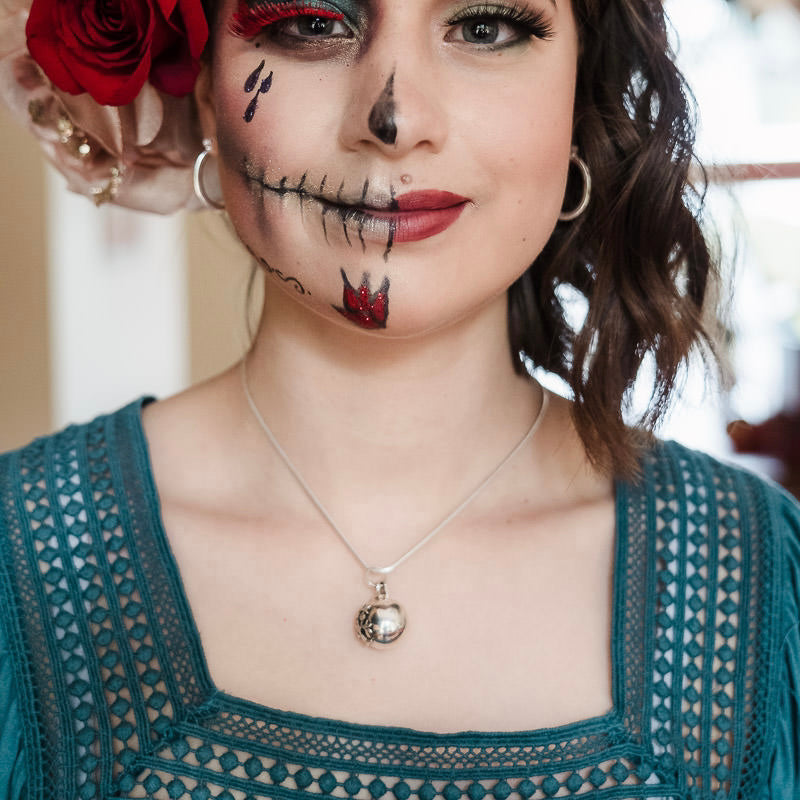
A common mistake is assuming a floral pendant must be sentimental. Plenty of people choose flowers for the craftsmanship, not the symbolism, and that is a perfectly good reason.
The Moon, Stars, and Mystical Interpretations of Silver
Moon and star motifs carry strong spiritual and mystical meaning, and silver is the metal most often paired with them.
Stars usually read as guidance, hope or destiny. A crescent moon signals cycles, change and renewal. Some wearers treat a moon pendant as a talisman for calm; others simply like the shape. You can see the motif worked in silver on our silver moon pendant.
Cross Pendant Meaning Across Faiths and Cultures
Cross pendant meaning is broader than most wearers realize. The cross is widely recognized as a religious symbol, and in Christian faith it is a sign of sacrifice and redemption.
In Christian traditions, a plain Latin cross reads as devotion, while a crucifix emphasizes sacrifice. Orthodox traditions often use a cross with an extra bar.
The reading gets personal. A cross inherited from a grandparent carries family memory; one bought for a baptism carries a promise. Our handmade La Cruz sterling silver cross pendant is a compact, high-polish piece suited to everyday wear.
Animal Pendant Meanings and What They Represent
Animal pendant meanings vary by creature, but the logic is consistent: each animal distills a trait the wearer wants to keep close. It is one of the oldest uses of jewelry symbols, and it survives because it works.
- Turtle or tortoise: patience, protection, long life and steady progress
- Dragon: strength, fortune and protection in East Asian traditions; in Mexican folk art, a bolder, more mythical character
- Snake: transformation and renewal, since the snake sheds its skin
- Bird: freedom and perspective
- Fish: abundance and adaptability
A common mistake is buying an animal charm purely on looks, then discovering the traditional meaning clashes with what you wanted to say. If symbolism matters to you, check the creature's associations first. Readers drawn to the turtle's protective reading can browse our turtle pendant charm in .925 sterling silver.
How to Identify a Pendant Symbol You Don't Recognize
Identifying an unfamiliar pendant symbol takes a repeatable process, not a lucky guess: describe the shape precisely, separate the design from any stamped marks, then match the design against known motif families.
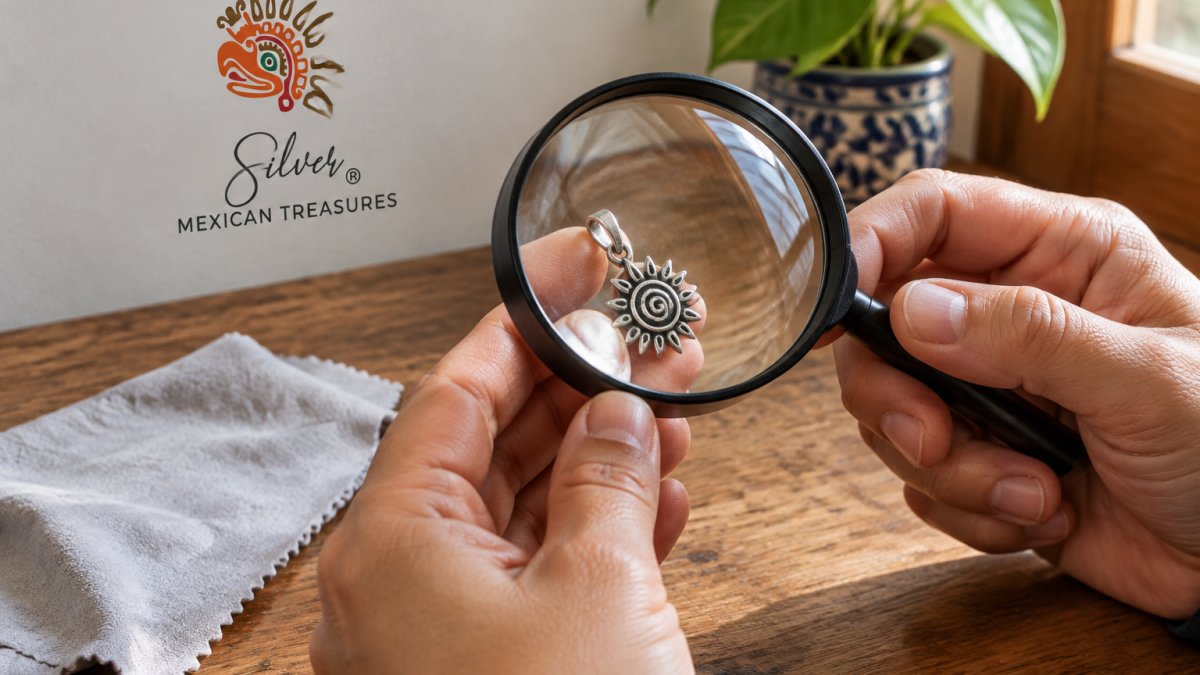
Start with a plain, written description. Work through these questions and note the answers:
- Is the figure geometric, botanical, animal, human, abstract or a monogram?
- Is it symmetric, and if so, along which axis?
- Does it contain lettering, dates, initials or a maker's name?
- Is the design raised, engraved, cut out or cast in relief?
- Are there secondary elements such as a border, halo, banner or knot?
Photograph both sides in daylight, including the bail and the back, and note any small marks near the bail or on the reverse. A phone macro shot or jeweler's loupe helps with tiny details.
Then check for stamps. This is where people go wrong most often, because a stamped mark and a decorative symbol can sit millimeters apart on the same pendant.
Separating Symbol Meaning from Silver Hallmarks
A hallmark is a stamped mark that records metal purity, maker or origin, and it is not a symbol in the decorative sense. The two get confused constantly because both sit on the same small object.
On sterling silver, the most common stamp is 925, meaning 92.5% silver with 7.5% alloy. You may also see STERLING, SP, or numeric marks such as 800 and 950, which indicate different fineness levels.
Watch out: a decorative mark that looks like a letter or a tiny figure is often a maker's mark, not a personal symbol. If you are trying to date or value a piece, read the hallmark first.
A Visual Identification Guide to Common Pendant Symbols
Use this guide to move from a description to a likely motif family.
Cross family. Look for two intersecting lines, usually with the longer axis vertical. Distinguish a plain Latin cross from a crucifix (which includes a figure), an Orthodox cross (extra bars), a Celtic cross (a ring around the intersection) and a plus-sign shape that may be decorative. Lookalike warning: a four-pointed star or compass rose can resemble a cross at a glance.
Moon and star family. A crescent moon has two curved edges meeting at points; a star usually has four, five or eight points. Distinguish a single star from a star-and-crescent combination, and note whether the moon faces left or right, since some traditional designs specify orientation. Lookalike warning: a stylized flower or sunburst can read as a star when small.
Tree and leaf family. Tree of Life designs show roots, a trunk and branches, often with a rounded canopy. Leaves and vines suggest growth and connection.
Animal family. Note the creature's posture and any accompanying elements.
Geometric and abstract family. Circles, triangles, spirals, knots and interlace patterns often carry cultural meanings that vary by tradition.
Monogram and letter family. Initials, dates and custom shapes are the fastest-growing category and resist any glossary because the wearer assigns the meaning.
When to Consult a Jeweler, Religious Specialist or Hallmark Reference
Some pendants need human expertise. Consult a jeweler if the piece may be antique, if the metal is unmarked, or if you need to know whether a stone or setting is original. Consult a religious specialist or cultural organization if the motif appears devotional and you want to avoid misreading it. Consult a hallmark reference or professional assay service if you need to date or value the piece.
A common pattern is that people research the design first and the metal second, then discover the two questions have separate answers. Keep them separate and you will get further, faster.
How Culture and History Change What a Symbol Means
Culture and history change a symbol's meaning more than any other factor, and this is the angle most guides skip.
| Symbol | Common Reading | Where It Shifts |
|---|---|---|
| Cross | Faith, sacrifice | Decorative in some folk traditions; a plus-sign shape in geometric design |
| Moon | Intuition, cycles | Purely aesthetic in modern design; lunar deity associations in older traditions |
| Tree | Growth, grounding | Family lineage in some cultures; world-axis symbolism in others |
| Snake | Renewal | Protection in some traditions; danger or temptation in others |
| Heart | Love, devotion | Friendship in some regions; religious devotion in some historical contexts |
Historical period matters too.
Religious context adds another layer.
Contemporary and personalized symbols, initials, dates, custom shapes, are the fastest-growing category, and they resist any glossary because the wearer assigns the meaning. That is not a weakness.
A practical rule follows: when you research a motif, note the tradition and period you are reading about, and do not assume a single meaning applies everywhere.
Choosing a Silver Pendant That Feels Personal
Choosing well comes down to three decisions: the motif, the size, and the metal. Get those right and the pendant stays in rotation for years.
Start with the motif. Pick a symbol whose meaning you actually believe, not one that photographs well.
If you want a step-by-step walkthrough of pendant size, chain length and the .925 stamp, our guide on how to choose a silver pendant necklace covers it in detail.
One honest limitation: handmade pieces vary slightly from one to the next.
Most jewelry shoppers can find a pendant that looks good. Finding one whose symbol means something to you, made by artisans paid fairly for hand-formed work, takes more care.
Frequently Asked Questions
What do common symbols on silver pendants mean?
Most silver pendant symbols fall into a few families. Crosses signal faith, hearts represent love and devotion, trees and flowers point to growth and renewal, and animals carry traits like strength or freedom. The same motif can shift meaning between cultures, so context matters. A Tree of Life pendant, for example, reads as connection and harmony in many traditions. When you know the family a symbol belongs to, you can usually interpret an unfamiliar piece with reasonable confidence.
What does a cross on a silver pendant symbolize?
Cross pendant meaning depends on the wearer. For Christians it is a statement of faith and protection, and it appears in baptism, confirmation, and memorial gifts. Outside religious use, a simple cross reads as balance or a personal marker of resilience. Design details matter too: a plain Latin cross, a Celtic cross with a ring, and an equal-armed cross each carry different cultural weight. A small polished cross like a handmade .925 sterling silver piece works for everyday wear or layering.
Do markings like .925 indicate a pendant's symbol or its silver content?
They indicate metal content, not meaning. A .925 stamp means the piece is 92.5% silver and 7.5% alloy, which is the sterling silver standard. Other stamps you may see include 800, 950, SP, and maker's or assay marks. None of these describe the design. Read the stamp for purity and origin, then interpret the motif separately. Mixing the two up is one of the most common reasons people misread an old or inherited pendant.
How can I identify an unfamiliar symbol on a silver pendant?
Start with the shape: is it geometric, floral, animal, or abstract? Note any letters, knots, or repeating patterns, then check the back for hallmarks that may point to a country or maker. Compare your piece against a visual symbol glossary, and search by description rather than by guesswork. If the motif is ambiguous, a jeweler or appraiser can help. Avoid assuming a religious or cultural meaning until you have ruled out a maker's mark or decorative flourish.
Can the meaning of a pendant symbol vary between cultures?
Yes, often significantly. The owl is wisdom in some European traditions and a bad omen in others. The dragon is a protective, auspicious figure in East Asian art but a danger symbol in much older Western storytelling. The evil eye appears across Mediterranean and Middle Eastern cultures with slightly different emphasis. This is why a single-symbol dictionary rarely tells the full story. Ask where a piece was made and by whom before settling on one interpretation.
How do I choose a silver pendant symbol that feels meaningful to me?
Pick the meaning you want to carry, not the one that looks most impressive. Write down two or three qualities you want the piece to represent, then match them to motifs: growth, protection, love, strength, or connection. Consider how often you will wear it and whether the size suits your daily style. A handmade pendant from a small-batch maker adds a story about craftsmanship on top of the symbol itself, which is often what makes a piece feel personal years later.
