
How to Tell Handmade Silver from Cast Jewelry
Last Updated: October 28, 2026
Quick Summary
To tell handmade silver from cast jewelry, inspect hidden surfaces for a casting seam, a sprue mark, or scattered porosity, and compare duplicates for identical details. Signs of handmade silver include tool marks, hammered texture, slight asymmetry, and visible solder joints. Weigh several clues together, since no single mark proves the method.
- Casting leaves a sprue mark, a small circular patch where molten silver was poured in.
- A straight casting seam across a curved surface is a strong cast signal.
- Identical duplicates with matching curves and texture point to a mold at work.
- A .925 stamp confirms silver purity but never proves how a piece was made.
- In Canada hallmarking is not mandatory, so stamps are largely self-declared.
Table of Contents
- What You'll Need Before You Start Inspecting
- Hand-Fabricated vs Cast Jewelry: The Core Difference
- How to Identify Cast Silver Jewelry: A Step-by-Step Checklist
- Signs of Handmade Silver Jewelry: What to Look For
- Sterling Silver Authenticity Marks and What They Don't Prove
- Weight, Durability, and Wear: What the Feel Tells You
- Where Visual Checks Stop: Limits and When to Ask a Jeweler
- Choosing Handcrafted Silver Worth Keeping
- Frequently Asked Questions
What You'll Need Before You Start Inspecting
You do not need a jeweler's bench to tell handmade silver from cast jewelry.
This guide covers what each clue means, where visual checks fail, and how to buy with confidence.
Casting pours metal into a mold; hand fabrication shapes metal with tools. Each method leaves different evidence.
Hand-Fabricated vs Cast Jewelry: The Core Difference
Hand-fabricated jewelry is shaped, joined, and finished with hand tools; cast jewelry is poured as molten silver into a mold. One builds up from wire and sheet, the other fills a cavity. Neither method is dishonest; the problem starts when a cast piece is sold as handmade.
How Casting Creates a Piece
Casting starts with a wax model encased in a plaster-like shell. The wax is melted out, leaving a negative impression, and molten silver pours in through a channel called a sprue. Once cooled, the shell is broken away and the sprue cut off, leaving a small mark, one of the best clues you will find.
How Hand Fabrication Builds a Piece
Hand fabrication works in reverse. A silversmith starts with silver sheet and wire, saws, files, bends, and hammers it into shape, then joins parts with soldering. Every step leaves a trace: hammer facets, fine parallel file lines, and solder joints you can feel before you see them, the fingerprints of handmade work.
How to Identify Cast Silver Jewelry: A Step-by-Step Checklist
Never scratch, file, acid-test, or heat a piece you do not own outright. A jeweler's loupe and a soft cloth are enough for the checks below. If a seller will not let you inspect the back of a piece under magnification, treat that as a red flag, not a reason to test it yourself.
Step 1: Set Up the Light and Loupe
Angle a soft white LED task lamp low across the surface, raking light reveals ridges, seams, and pits that vanish under overhead light. Hold the 10x loupe to your eye and bring the piece to it, not the reverse. Wipe the surface with a clean cotton cloth first; fingerprints hide fine detail.
Step 2: Check the Edges and Hidden Surfaces First
Start with the least obvious surfaces: the inside of a ring band, the back of a pendant, the underside of a bail, the inside of a clasp. Cast edges feel rounded and soft because the metal filled a cavity and was polished back; hand-cut edges feel crisper because they were sawed and filed.
Step 3: Look for a Mold Seam
A casting seam is a faint line where two mold halves met, and it often survives polishing. Run a fingernail across it and you may feel a slight ridge. A straight seam across a curved surface is a strong cast signal; hand fabrication does not produce that geometry.
Step 4: Find the Sprue Point
The sprue is the channel the molten silver poured through. Once cut and filed, it leaves a small circular patch, slightly flatter or rougher than the surrounding metal, usually on a hidden side or the base. This is one of the most reliable single clues, but not proof on its own: a handmade piece can include a cast component with its own sprue mark.
Step 5: Inspect the Surface for Porosity
Porosity means tiny air pockets trapped as the metal cooled, small round craters or pinholes, often clustered in thicker areas. Hand-fabricated pieces can show it too, especially near solder joints, so treat it as supporting evidence. The pattern matters: scattered pits across a thick cast section point one way; a few pits at a solder seam point another.
Step 6: Compare Duplicates
The strongest cast signal is duplication. If a seller shows five of the same design and every curve, dent, and texture matches exactly, that is a mold at work. Handmade pieces vary, even within a matching set. Ask to see two pieces side by side, or compare photos of the same design from the seller's listings.
Step 7: Weigh the Evidence, Not the Metal
Cast pieces are often heavier in the same design because the metal is solid throughout; hand-fabricated pieces are usually lighter. But weight is a weak clue on its own: a thick handmade band can outweigh a thin cast one. Use it only to support what the seams, sprue marks, and duplicates already suggest.
Aros Earrings – Handcrafted Wire Hoop Dangles in .925 Sterling Silver →
What This Checklist Can and Cannot Prove
Work the checklist in order, stop when the evidence converges, and never let a single mark decide the question. Most pieces reveal their method through two or three clues together, not one.
Signs of Handmade Silver Jewelry: What to Look For
Signs of handmade silver jewelry include tool marks, hammered texture, slight asymmetry, visible solder joints, and small design variations between pieces. Handmade work carries evidence of the maker's hand.
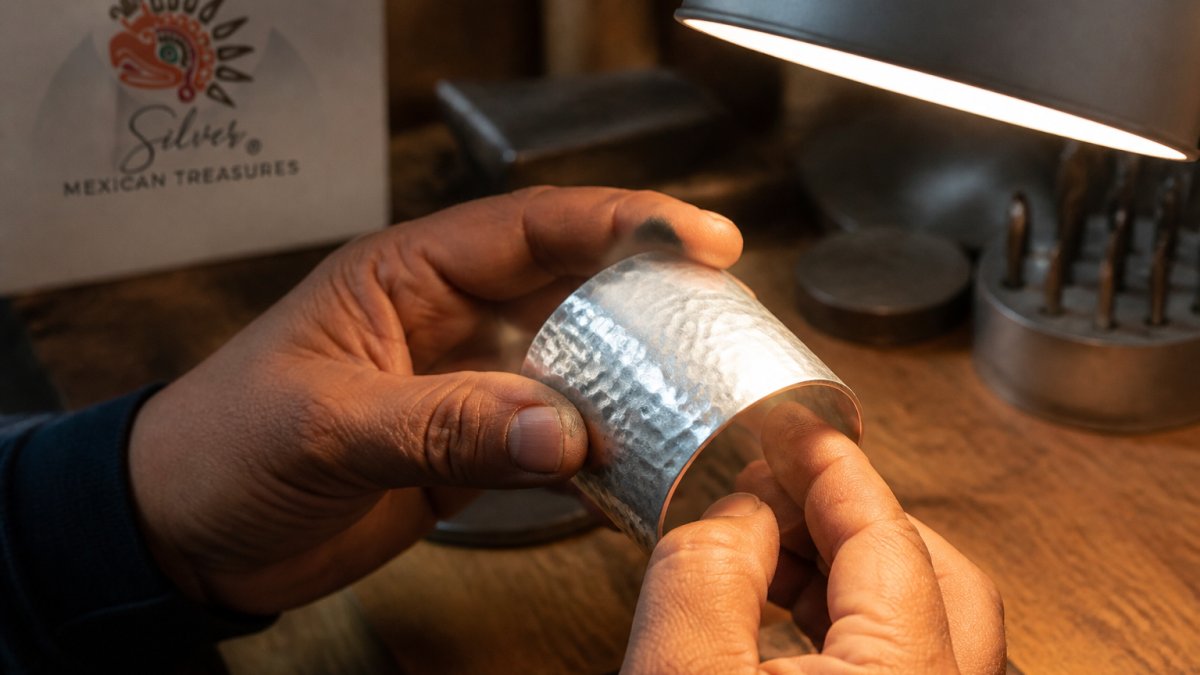
Tool Marks, Hammering, and Surface Texture
Our hammered bracelet shows what real hammer marks look like up close: irregular facets, each one slightly different.
Sterling Silver Authenticity Marks and What They Don't Prove
| What you are checking | What it tells you | What it does not tell you |
|---|---|---|
| .925 or "sterling" stamp | Silver purity | How the piece was made |
| Maker's mark or hallmark | Who made or assayed it | Whether it was hand-fabricated |
| Sprue mark or mold seam | Likely casting | Silver quality |
| Hammer marks and file lines | Likely hand fabrication | Silver purity |
What Hallmarks Can and Cannot Establish
In Canada there is no mandatory hallmarking system for silver, so stamps are largely self-declared, a claim by the maker or seller, not a government assay, which makes visual inspection more important, not less. A maker's mark helps trace provenance but still does not prove hand fabrication; a workshop can cast and stamp its own pieces.
What Common At-Home Tests Can and Cannot Establish
- Magnet test: Sterling silver is not magnetic, so a magnet that sticks suggests a magnetic base metal. But a magnet that does not stick proves very little, because many non-silver metals such as copper, brass, and some stainless alloys are also non-magnetic. A pass is not proof of silver.
- Acid test: Jewelry-testing acids can confirm or rule out silver content on a small rubbed area, but they leave a mark and can damage a finish. They are a jeweler's tool, not a buyer's inspection step.
- Scratch test: Scratching a piece to see the metal underneath is destructive and voids most return policies. Do not do it on a piece you have not bought.
- Discoloration and skin residue: A greenish residue on skin usually means plating or a copper alloy, not sterling. This is a wear clue, not a purity test.
Silver Plating Is a Separate Trap
Silver plating is a separate trap from casting. Plated pieces can look identical to solid silver at first glance. Wear reveals them: plating rubs off in high-contact areas like ring bands and clasp edges, showing a base metal underneath. A plated piece can also be cast, so plating and casting are not the same issue. One is about the surface layer, the other about how the object was formed.
Hybrid Pieces Blur the Method Question
A hallmark answers a purity question. A sprue mark, seam, or tool mark answers a method question. Do not let one stand in for the other, and do not use a destructive test to answer either.
Weight, Durability, and Wear: What the Feel Tells You
What you should watch for over time:
A cast ring with thick walls will outlast a delicate handmade band in daily wear. Method is not the same as toughness. Our article on whether handmade sterling silver is more durable digs into that trade-off.
Where Visual Checks Stop: Limits and When to Ask a Jeweler
Once inspection has limits, buy from sellers who stand behind their claims. Our guide to trusted shops for verified handcrafted silver covers where to look.
Choosing Handcrafted Silver Worth Keeping
At Silver Mexican Treasures, our pieces are handcrafted in small batches by artisan partners in Taxco, and each one is lab-certified .925 sterling silver.
Look for these signals before you buy: why choose handmade sterling silver for its quality and ethics.
When you are ready to browse, explore the collection.
We built Silver Mexican Treasures around the idea that you should never have to guess. Every piece is handcrafted in small batches, lab-certified as .925 sterling silver, and sourced through direct partnerships with Taxco artisans. Explore the collection.
Frequently Asked Questions
Does a .925 stamp prove that silver jewelry is handmade?
No. A .925 stamp says nothing about how the piece was made.
Is cast silver jewelry less valuable than hand-fabricated silver?
Not automatically. The silver content is the same in both, so the metal value is close. What differs is labor. A hand-fabricated piece takes an artisan hours of forming, soldering, and finishing, which raises the price point. A cast piece made in high production volume costs less to produce. Value depends on design, finish, and the work behind the piece, not the method alone.
Can a jeweler tell whether silver jewelry was cast or fabricated?
Often, yes. A jeweler can spot casting seams, sprue points, and porosity under magnification, and can identify forging marks, solder joints, and hand-finished surfaces. Some pieces blend both methods, which makes the call harder. If you are unsure, ask a jeweler to examine the piece under a loupe before you buy or resell it.
How can you check silver jewelry without damaging it?
Use a loupe or a phone camera zoom to inspect edges, seams, and the inside of the band. Weigh the piece in your hand and compare it to similar items. Look for a hallmark and check for repeated identical designs. Avoid scratch tests, acid tests, or bending the metal, since these can damage the finish or the piece itself.
