
How to Verify Artisan Fair Trade Jewelry
Table of Contents
- What Does Fair Trade Jewelry Mean for Artisans
- Understanding Fair Trade Certifications and Standards
- Tracing Supply Chain Transparency and Provenance
- How to Identify Authentic Sterling Silver Jewelry
- How to Spot Greenwashing in Jewelry Brands
- Questions to Ask Jewelers Before Purchasing
- Verifying Ethical Sourcing Through Direct Partnerships
- Frequently Asked Questions
Last Updated: September 21, 2026
What Does Fair Trade Jewelry Mean for Artisans
Fair trade jewelry ensures artisans receive equitable compensation, work safely, and maintain creative control. When you verify artisan fair trade jewelry, you confirm these protections are real, not just marketing.
Fair trade means artisans receive stable income, retain design ownership, have input on production decisions, and benefit from community investment in education, healthcare, and equipment.
Most jewelry passes through multiple middlemen, each extracting margin while artisans' earnings shrink. Fair trade shortens the chain and protects artisan income.
Understanding Fair Trade Certifications and Standards
Fair trade certifications establish standards for wages, working conditions, and transparency, enforced through audits and third-party oversight. When you verify artisan fair trade jewelry, seek certifications with this enforcement mechanism.
Certification bodies vary in focus and rigor. The strongest require documented fair wages, safe conditions, community benefit, material traceability, and prohibition of forced or child labor.
How to Verify a Certification Number Against Public Registries
Certification marks on packaging mean little without verification. Check the certification number against the issuing body's public registry to confirm active certification.
Distinguishing Artisan-Specific Certifications from Industrial Standards
Artisan-specific certifications require direct brand-artisan relationships, protect creative control, emphasize skill preservation, and include traditional techniques. Industrial standards focus on wages and safety but may allow multiple intermediaries and don't distinguish handcrafted from mass-produced work.
Tracing Supply Chain Transparency and Provenance
Most jewelry brands can't trace materials to source. When you verify artisan fair trade jewelry, confirm the brand documents material origin, custody transfers, and lab testing. Ask for the artisan's name and material sourcing, if they can't answer with documentation within days, transparency is limited.
How to Identify Authentic Sterling Silver Jewelry
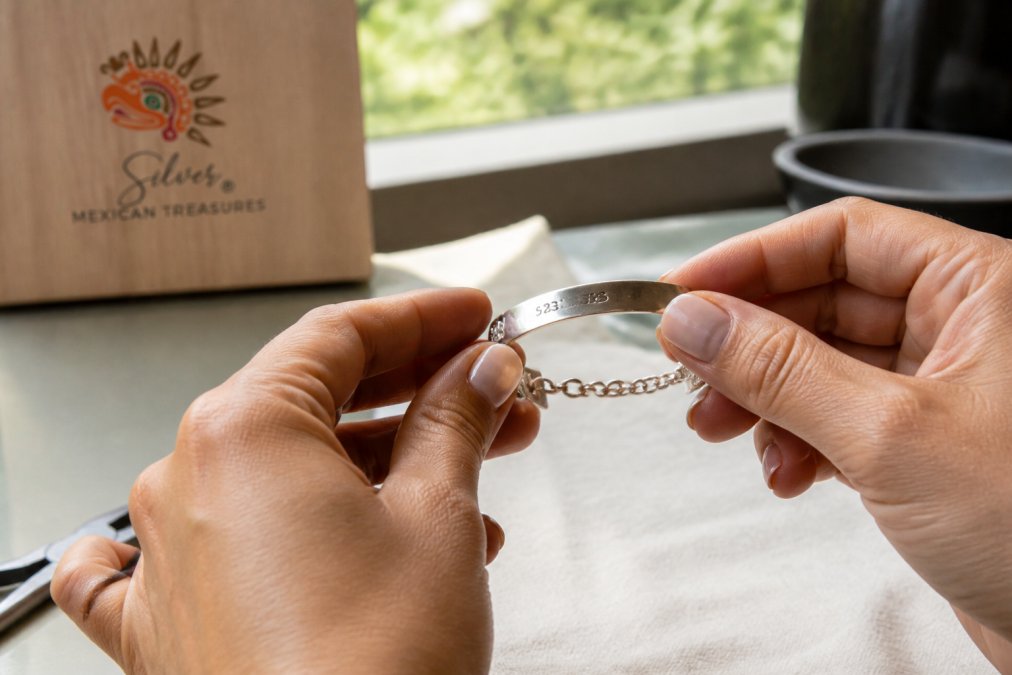
Genuine .925 sterling silver carries crisp, evenly impressed hallmarks stating "925," "Sterling," or "Ster" in inconspicuous locations. Examine under magnification, fake hallmarks appear shallow or uneven. Sterling silver is dense and non-magnetic; light pieces or those attracted to magnets contain base metals. Artisan work shows hand-finishing marks and irregularities proving human craftsmanship.
How to Spot Greenwashing in Jewelry Brands
Greenwashing uses ethical language without proof. When you verify artisan fair trade jewelry, watch for vague claims without standards, fair trade claims without certification, artisan emphasis without wage disclosure, unverified environmental claims, and artisan stories lacking compensation details.
Visual Identification of Legitimate vs. Fake Certification Logos
Fake certification logos are common greenwashing. Learning to distinguish real marks from invented ones is critical.
Red flags for fake or misleading logos:
-
Generic or vague badge names. Logos that say "Ethically Made," "Eco-Friendly," or "Fair Trade Certified" without naming a specific organization are often self-created. Real certifications name the issuing body explicitly (e.g., "Certified by [Organization Name]").
-
No verifiable information. If the logo includes no certification number, website, or way to verify it, it's likely fake. Legitimate certifiers always provide a verification path.
-
Inconsistent or low-quality design. Fake logos often appear pixelated, poorly aligned, or inconsistently sized across materials. Professional certification bodies maintain strict design standards.
-
No audit date or expiration. If a logo claims certification but includes no date or validity period, there's no way to confirm it's current. Real certifications are time-bound and regularly renewed.
-
Multiple conflicting logos. If a brand displays several different certification marks without explanation, verify each one independently. Some brands stack logos to create an impression of credibility without holding all of them. A brand holding multiple legitimate certifications will explain why and provide documentation for each.
-
Logo appears only on marketing materials, not on product tags. Legitimate certifications appear on the actual product or official product documentation. If a logo is only on the website or marketing brochure but not on the jewelry itself or its official tag, the certification may not apply to the actual product.
Comparing Transparency Across Brands
Authentic brands provide specifics. They name their artisans, publish wage data or ranges, disclose their supply chain, and welcome scrutiny. They explain exactly which certifications they hold and link to audit results. They acknowledge limitations, no brand is perfect, but transparent ones discuss what they're working to improve.
Compare claims across brands. Create a simple checklist:
Transparency checklist:
- Brand names specific artisans or workshops
- Brand provides certification number(s) and links to verification registry
- Brand publishes wage ranges or payment structure for artisans
- Brand discloses material sourcing (specific mines, recyclers, or suppliers)
- Brand provides lab certification or third-party testing documentation
- Brand publishes audit reports or summaries from certifying bodies
- Brand answers specific questions about working conditions and supply chain
- Brand acknowledges limitations and discusses ongoing improvements
Questions to Ask Jewelers Before Purchasing
Direct conversation with a jeweler reveals their actual commitment to fair trade and transparency. Ask these questions and pay attention to how thoroughly they answer:
On artisan compensation:
- What percentage of my purchase price goes directly to the artisan who made this piece?
- Can you provide documentation of the wage or payment structure?
- Are artisans paid per piece, hourly, or through another arrangement?
On supply chain:
- Where does the silver come from? (Specific mine, recycling facility, or supplier name)
- Can you trace the complete chain from raw material to finished piece?
- Do you have certifications for conflict-free or recycled status?
On working conditions:
- Where is this piece made? (Specific location and workshop)
- What certifications do you hold for labor practices?
- Can I see audit reports or third-party verification?
On authenticity:
- Is this piece lab-tested for metal purity? Can you provide the report?
- What guarantee do you offer if the piece doesn't meet stated specifications?
- Can you provide the name and background of the artisan who made this?
Verifying Ethical Sourcing Through Direct Partnerships
The most reliable verification comes from brands that work directly with artisans rather than through middlemen. Direct partnerships eliminate layers of the supply chain where accountability typically breaks down. When a brand sources directly, they control the relationship, set the standards, and can verify conditions firsthand.
Direct partnerships typically involve:
- Long-term relationships with specific artisans or workshops rather than one-off purchases
- Regular communication and site visits to verify working conditions
- Collaborative design processes where artisans contribute creative input
- Stable, predictable orders that allow artisans to plan production and invest in their businesses
- Shared commitment to continuous improvement in wages, conditions, and environmental practice
| Verification Method | What It Confirms | Reliability |
|---|---|---|
| Lab certification | Metal purity and composition | High (third-party testing) |
| Hallmark inspection | Authenticity and origin | Medium (can be counterfeited) |
| Certification body audit | Fair wages and working conditions | High (independent oversight) |
| Direct brand communication | Supply chain transparency | Medium to High (depends on documentation) |
| Artisan naming | Direct partnership | High (specific, verifiable detail) |
| Wage documentation | Equitable compensation | High (concrete numbers) |
Frequently Asked Questions
How can I verify the authenticity of artisan fair trade jewelry?
Look for three key markers: hallmark stamps (such as .925 for sterling silver), third-party certifications from recognized bodies, and transparent supply chain documentation. Ask the jeweler for proof of artisan partnerships, certificates of authenticity, and lab certification if applicable. Reputable artisan fair trade jewelry sellers provide traceability information showing where and by whom the piece was made, along with details about fair wages and working conditions.
What certifications should I look for in fair trade jewelry?
Seek certifications from established organizations that audit supply chains and verify ethical labor practices. Look for third-party auditing marks, hallmark stamps for precious metals, and documentation of cooperative membership or fair trade partnerships. Brands committed to fair trade jewelry typically display these credentials openly and can explain the certification process. Avoid vague claims like 'ethically sourced' without supporting documentation or verifiable third-party validation.
How do I know if jewelry is truly handmade by artisans?
Authentic handcrafted jewelry shows visible signs of artisan work: slight variations in texture, weight inconsistencies between pieces, and individual character marks. Request photos of the artisan at work or documentation of the craftsmanship process. Direct partnerships with artisan communities often include artisan names, photos, or bios. Ask about production methods and whether pieces are made in small batches. Mass-produced items typically lack these personalized touches and documentation.
What is the difference between ethical jewelry and fair trade jewelry?
Ethical jewelry focuses on responsible sourcing of materials and environmental impact, while fair trade jewelry specifically ensures artisans receive fair wages, safe working conditions, and long-term partnerships. Fair trade jewelry includes the ethical component but adds verified due diligence on human rights and sustainable development for artisan communities. Fair trade requires third-party auditing and accountability, whereas ethical claims alone may lack independent verification. Both matter, but fair trade provides stronger protections for artisans.
How does direct partnership impact the authenticity of silver jewelry?
Direct partnerships eliminate middlemen, ensuring more money reaches artisans and creating accountability for quality and fair wages. When a brand works directly with artisans, they can verify supply chain transparency, confirm artisan identities, and document working conditions. This direct relationship produces authentic handcrafted pieces with traceable provenance. Brands with direct artisan partnerships typically provide artisan information, production details, and verifiable communication channels, making their fair trade claims more credible and verifiable.