
Is Handmade Sterling Silver More Durable?
Table of Contents
- What Makes Handmade Sterling Silver Different
- How to Care for Sterling Silver Jewelry
- Sterling Silver vs Silver Plated Durability
- Is Sterling Silver Good for Everyday Wear?
- The Role of Craftsmanship in Handmade Sterling Silver Durability
- How to Identify Genuine Handmade Sterling Silver
- Conclusion
- Frequently Asked Questions
Last Updated: September 16, 2026
What Makes Handmade Sterling Silver Different
Handmade sterling silver is jewelry shaped, soldered, and finished by an individual artisan rather than stamped out by a machine, and that difference in construction is exactly what determines how long a piece survives daily wear. At Silver Mexican Treasures, we work directly with Taxco artisans who form each piece by hand, which means we see firsthand how craftsmanship affects durability. The question of whether handmade sterling silver is more durable comes down to three things: alloy quality, joint construction, and finishing. A hand-fabricated piece typically has thicker cross-sections and reinforced connections at stress points, while mass-produced jewelry often uses the minimum metal required to hold its shape. That said, handmade is not automatically better. A poorly made handcrafted piece can fail faster than a well-engineered cast one.
How to Care for Sterling Silver Jewelry
Caring for sterling silver jewelry comes down to three principles: keep it dry, keep it sealed, and polish gently. The routine below takes about five minutes a week, but the reasoning behind each step matters more than the checklist itself.
- Wipe each piece with a soft polishing cloth after wearing
- Remove jewelry before swimming, showering, or applying lotion
- Store pieces individually in airtight bags or a lined box
- Use a silver polishing cloth for light tarnish, not abrasive pastes
- Have clasps and jump rings checked once a year
Why tarnish happens (and why it is not a defect)
Tarnish is oxidation, a natural reaction between the copper in the sterling alloy and sulfur compounds in the air, on skin, and in certain foods and fabrics. It affects every silver alloy, including fine silver, though the copper content in sterling makes it more visible. Pieces worn regularly tarnish more slowly because skin contact and friction keep the surface active and redistribute the reaction evenly.
The over-polishing trap
A common mistake is over-polishing. Abrasive compounds and polishing wheels remove a thin layer of metal each time they are used, and repeated polishing eventually thins a ring shank or a chain link. For most pieces, a soft cloth is enough. Reserve abrasive pastes for heavy tarnish, and use them sparingly.
For pieces with intentional oxidation in the recesses, avoid liquid dips entirely. Dips strip the dark contrast the artisan applied and leave the recesses bare, which is difficult to restore by hand.
Storage and environment
Where a piece lives between wears has a measurable effect on how often it needs attention. Airtight bags, tarnish-resistant pouches, and lined boxes limit exposure to airborne sulfur. A dry drawer is better than a humid bathroom cabinet. Silica gel packets in a jewelry box help in damp climates.
Care for handmade construction specifically
Handmade pieces have a few care considerations that mass-produced jewelry does not:
- Soldered joints: Hand-soldered connections are strong but can be stressed by repeated pulling. Remove bracelets and necklaces by the clasp, not by tugging the chain.
- Work-hardened metal: Hand-shaped pieces are often work-hardened during forming, which makes them stiffer and more springy than cast equivalents. Avoid bending them back and forth, which can fatigue the metal at a single point.
- Intentional patina: If the artisan applied oxidation for contrast, clean around it rather than over it.
- Stone settings: Hand-set stones should be checked by a jeweler annually, since a loose setting is easier to tighten than to replace.
Repairability: the advantage handmade pieces hold
One of the least discussed durability factors is repairability. A handmade sterling piece can typically be re-soldered, re-polished, resized, and re-finished by a jeweler without compromising the design. Mass-produced cast pieces are often harder to repair because the original construction method and alloy batch are unknown, and some plated or hollow pieces cannot be repaired at all. This means the effective lifespan of a well-made handmade piece is not just longer, it is extendable.
Canadian guidelines on the care and handling of precious metal jewelry
Sterling Silver vs Silver Plated Durability
Sterling silver and silver plated jewelry differ in one decisive way: sterling is solid alloy all the way through, while plated jewelry is a thin silver layer over a base metal. That layer is measured in microns, and once it wears through, the base metal is exposed. Plated pieces typically lose their silver surface at friction points first, such as the underside of a ring or the clasp of a bracelet.
| Feature | Sterling Silver (925) | Silver Plated |
|---|---|---|
| Composition | 92.5% silver, 7.5% other metals | Thin silver layer over base metal |
| Wear-through risk | None, solid throughout | High at friction points |
| Tarnish behavior | Surface oxidation, fully reversible | Layer degrades, not reversible |
| Repairability | Can be re-polished and re-soldered | Usually not repairable |
| Skin reactions | Rare with quality alloy | Possible once base metal shows |
The practical takeaway: plated jewelry is fine for occasional wear, but it is not a long-term purchase. Sterling silver, by contrast, can be restored rather than replaced.
Is Sterling Silver Good for Everyday Wear?
Sterling silver is good for everyday wear, provided the piece is well constructed and the wearer understands how daily exposure interacts with the alloy. The 92.5% silver content gives the metal enough hardness for daily use while retaining the malleability that lets a jeweler shape and repair it. Pure fine silver, at 99.9%, is too soft for rings and clasps, which is why copper is added to create the sterling alloy in the first place.
What most guides skip is that the 7.5% copper is the part of the alloy that reacts to your environment. Copper is what tarnishes first, what discolors under certain conditions, and what determines how a piece ages on your skin. Understanding that reaction is more useful than memorizing the purity number.
How everyday exposures affect the alloy
- Sweat and skin pH: Perspiration is slightly acidic and contains trace sulfur compounds. On most wearers this produces a slow, even patina that polishes off easily. On wearers with more acidic skin chemistry, the copper at the surface can react faster, leaving a dark smudge on the finger or a dull cast on the metal. This is a surface reaction, not structural damage, and it reverses with a polishing cloth.
- Perfume, lotion, and sunscreen: These products often contain sulfur and other compounds that accelerate tarnish. Applied directly to a ring or bracelet, they concentrate the reaction at one spot. The practical fix is to apply products first, let them absorb, then put jewelry on.
- Humidity and air quality: Sulfur in the air is the primary driver of tarnish. A piece stored in a humid bathroom or near a kitchen will tarnish noticeably faster than one kept in a dry, sealed environment. Coastal and industrial areas tend to have higher airborne sulfur than dry inland climates.
- Chlorinated water: Pool water and hot tubs are hard on sterling because chlorine is an aggressive oxidizer. Repeated exposure dulls the surface and, over time, can pit the metal at high-contact points. Remove rings and bracelets before swimming.
- Abrasion: Everyday friction against keys, gym equipment, or a desk edge gradually wears the surface. This is normal and reversible through polishing, but it is the reason high-contact pieces lose their mirror finish faster than pendants and earrings.
What this means for choosing a daily-wear piece
Design matters more than the alloy itself. A delicate chain with a thin jump ring will fail faster than a heavier chain with a soldered clasp, regardless of silver purity. For a piece you intend to wear every day:
- Choose reinforced connections over fine, hollow, or filigree-heavy construction for rings and bracelets.
- Prefer solid bands and thicker gauges at stress points.
- Accept that a matte or brushed finish hides everyday abrasion better than a high polish.
- Expect to polish a daily-worn ring every few months, and a pendant perhaps once a year.
The Role of Craftsmanship in Handmade Sterling Silver Durability
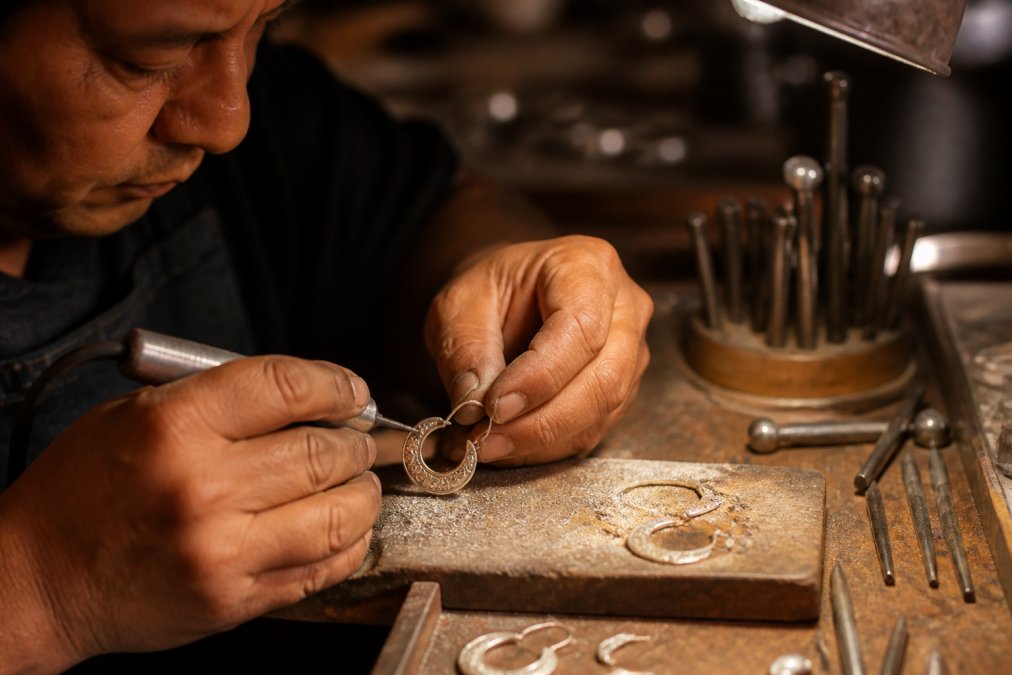
Craftsmanship affects durability more than any other single factor, because it determines how the metal is joined, how thick the stress points are, and how the surface is finished. A hand-fabricated piece lets the artisan thicken a clasp, solder a joint fully, and work-harden the metal as it is shaped, all of which extend service life.
How to Identify Genuine Handmade Sterling Silver
Identifying genuine handmade sterling silver comes down to three checks: the hallmark, the construction details, and the finish.
Conclusion
Buying silver jewelry means accepting that durability is not a single specification.
Frequently Asked Questions
Does .925 sterling silver tarnish faster than other metals?
Sterling silver tarnishes when it reacts with sulfur compounds in the air, but it does not tarnish faster than other precious metals like copper or brass. The 92.5% silver content in sterling silver is highly resistant to corrosion, though the 7.5% copper alloy can cause surface oxidation over time. Regular cleaning and proper storage slow this process significantly.
How does the craftsmanship of handmade silver affect its longevity?
Handmade sterling silver often lasts longer because artisans control the alloy composition, solder joints, and finishing techniques. Unlike mass-produced pieces that may use weaker solders or thin plating, handmade jewelry typically features thicker metal and stronger connections. This craftsmanship reduces the risk of breakage, tarnish, and wear over years of daily use.
Can I wear 925 sterling silver jewelry every day?
Yes, 925 sterling silver is durable enough for daily wear. Its 92.5% silver content gives it strength, while the copper alloy adds scratch resistance. To keep it looking its best, remove jewelry before swimming or showering, and clean it regularly with a soft cloth. Handmade pieces with reinforced clasps and thick bands handle everyday use especially well.
Is sterling silver considered cheap jewelry?
Sterling silver is a precious metal, not cheap jewelry. It contains 92.5% pure silver, which gives it real value and durability. While it costs less than gold or platinum, sterling silver is a high-quality material used in fine jewelry. Handmade sterling silver pieces often carry additional value because of their unique craftsmanship and ethical sourcing.